
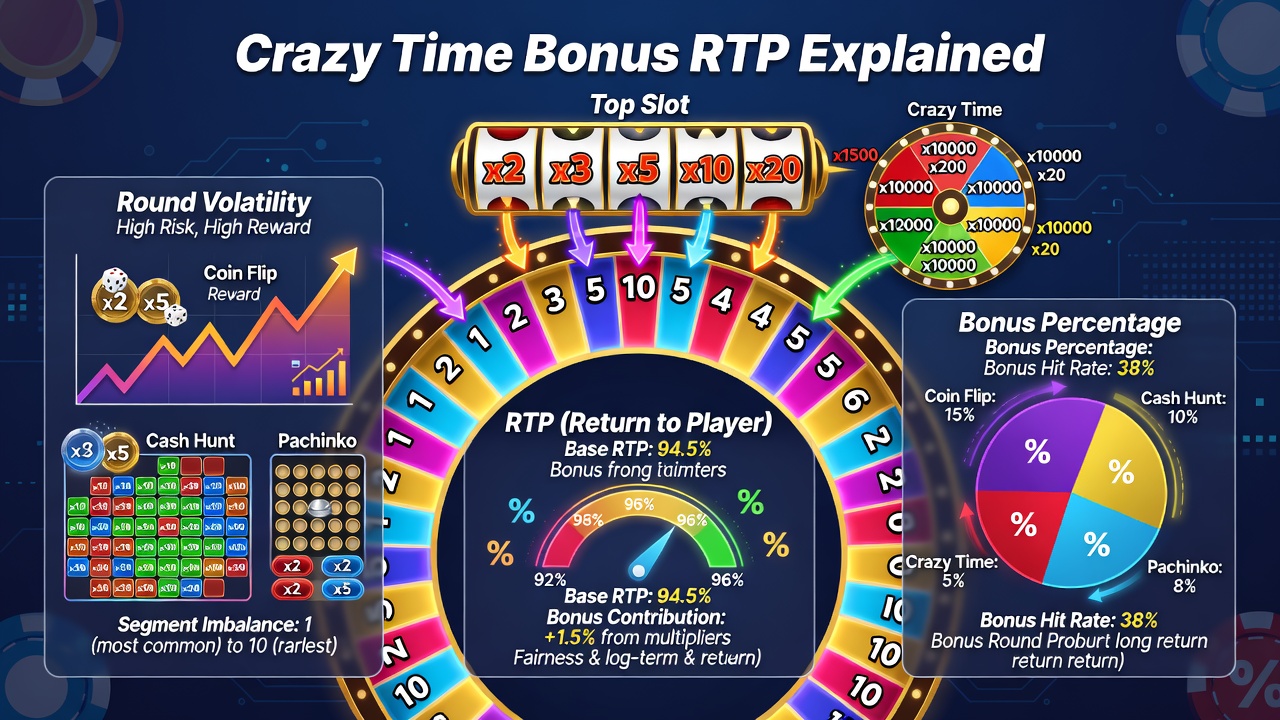
A single spin of the Crazy Time wheel can pay out 2x your stake or 25,000x it, and that gap explains almost everything players misunderstand about the game's return figures. Most people glance at a headline RTP percentage, assume it applies evenly across every betting option, and walk away confused when their bonus round session doesn't match expectations. The truth is more layered: each segment on the wheel carries its own return rate, its own volatility profile, and its own long-term behavior.
Understanding crazy time bonus RTP requires separating the base game math from the bonus round math, because the two operate on different timelines and different payout curves. The four bonus features - Coin Flip, Cash Hunt, Pachinko, and Crazy Time - don't just add excitement; they fundamentally reshape how often you win and how much variance you absorb along the way. For players who want a clear breakdown of how these numbers are calculated and verified, resources like crazy time bonus round rtp documentation offer useful reference points for cross-checking published figures against actual game behavior.
This piece breaks down what RTP actually measures, how volatility interacts with it, and why the bonus percentage you see quoted rarely tells the full story on its own.
What RTP Really Means in Crazy Time
Return to Player is a theoretical long-run average, not a promise about any individual session. When a game publishes an RTP percentage, it describes the proportion of all wagered money that gets returned to players collectively over millions of rounds. Crazy time RTP return to player figures are calculated by simulating enormous volumes of spins and averaging the results across every possible outcome, including the rare top-slot multipliers that skew the math disproportionately.
The Theoretical vs. Actual Return Gap
Theoretical RTP is a mathematical constant baked into the wheel's design and the game's probability engine. Actual return in any given session - an hour, a day, even a week - can swing wildly above or below that number. This gap is not a flaw; it's the nature of variance in a game built around a physical-style wheel with 54 unbalanced segments.
How Software Providers Calculate RTP
Providers run exhaustive simulations covering every segment, every bonus trigger, and every multiplier outcome before certifying a live game. These simulations account for the frequency of each number segment (1, 2, 5, 10) alongside the four bonus games, weighting each by its probability of appearing and its average payout when triggered.
Why RTP Differs Slightly Between Bet Types
Betting on the number 1 produces a different RTP curve than betting on Crazy Time itself, because each bet type carries distinct hit frequency and payout multiplier combinations. This is the first clue that a single blanket RTP figure oversimplifies the real picture.
- Number bets (1, 2, 5, 10) generally offer more frequent, smaller wins
- Bonus round bets (Coin Flip, Pachinko, Cash Hunt, Crazy Time) hit less often but carry higher ceiling payouts
- Top slot multipliers apply universally but influence bonus-bet RTP more heavily than number-bet RTP
Crazy Time Bonus Round RTP Breakdown
Each of the four bonus rounds has its own internal return rate, and lumping them together under one average hides meaningful differences. The crazy time bonus round RTP for Coin Flip tends to sit differently from Pachinko or Cash Hunt, largely because of how multipliers get assigned within each mini-game.
Coin Flip RTP Characteristics
Coin Flip is the simplest bonus round - a two-sided coin with a multiplier on each face. Its return profile is comparatively steady because the outcome space is binary, making it the lowest-variance bonus round of the four.
Cash Hunt RTP Characteristics
Cash Hunt presents 108 concealed values on a grid, and the player selects one. The spread of possible multipliers is wide, which pushes both the ceiling and the swing of outcomes higher than Coin Flip, while still trailing Crazy Time in raw volatility.
Pachinko RTP Characteristics
A puck drops through a field of pegs and lands on one of many multiplier slots, occasionally hitting a doubling slot that sends it back up for another drop. This mechanic introduces a compounding element that can meaningfully boost payout size in a way the other bonus rounds don't replicate.
Crazy Time Bonus RTP and the Flapper Wheel
The flagship bonus round uses a secondary wheel with a spinning flapper, four colored segments, and the potential for enormous multiplier stacking. Crazy time bonus RTP here reflects the highest-variance mechanic in the entire game, with the widest distance between typical and jackpot outcomes.
Understanding Crazy Time Bonus Round Volatility
Volatility measures how much outcomes deviate from the average, independent of what that average actually is. Two betting options can share a similar RTP percentage while producing wildly different player experiences purely because of volatility differences.
Low, Medium, and High Volatility Segments
Number bets sit at the lower end of the volatility spectrum - frequent small wins keep the bankroll ticking over without dramatic swings. The bonus rounds occupy medium-to-high volatility territory, and crazy time bonus round volatility peaks specifically in the Crazy Time segment itself, where multiplier stacking can produce payouts thousands of times the wager.
Why Volatility Matters More Than RTP for Session Experience
Two bets with identical long-term RTP can feel completely different across a single evening of play. A low-volatility bet delivers steady, modest returns; a high-volatility bet delivers long dry stretches punctuated by occasional outsized wins. Bankroll size and session length should influence which volatility profile makes sense for a given player.
The Role of the Top Slot Multiplier
Before each spin, the top slot randomly assigns a multiplier to one or two segments, sometimes stacking multipliers when the same segment is selected twice. This mechanic injects an additional layer of variance on top of the base wheel and bonus round outcomes, amplifying volatility further during rounds where a multiplied segment hits.
Crazy Time RTP Percentage: What the Numbers Actually Show
Published crazy time RTP percentage figures typically fall within a range depending on which bet type is selected, generally hovering in the mid-90s for number bets and shifting slightly for bonus bets once top slot multipliers are factored into the long-run average.
Comparing RTP Across Bet Segments
Number 1 bets, being the most frequent winners, often show a marginally different RTP than Number 10 bets, which hit far less often but pay proportionally more. This inverse relationship between hit frequency and payout size is standard across probability-based wheel games.
How Multipliers Affect the Published Percentage
The top slot's random multiplier assignment nudges the effective RTP upward over time, since it periodically boosts payouts on the number and bonus segments without altering the base probability of landing there. This is why long-run simulations, rather than short observation windows, produce the most reliable percentage figures.
Reading RTP Transparency Reports
Reputable studios publish their RTP figures and update them when game mechanics change. Cross-referencing these figures against independent auditing bodies gives players a more grounded understanding than relying on forum anecdotes or short-session screenshots.
How Bonus Percentage Shapes Long-Term Strategy
Bonus percentage - the frequency and scale at which bonus rounds trigger and pay - directly interacts with betting choices. Players who concentrate wagers on bonus round bets are effectively trading consistency for upside potential.
Balancing Bet Allocation Across Segments
Spreading stakes across number bets and one or two bonus rounds can smooth out variance while still preserving exposure to larger multiplier events. Concentrating everything on a single high-volatility bonus bet maximizes potential upside but also maximizes the chance of a prolonged losing stretch.
Bankroll Management Under High Volatility
Because bonus round hits are infrequent relative to number bets, a bankroll built for bonus-heavy betting needs enough depth to survive multiple non-triggering rounds without exhausting funds before a payout arrives.
Session Length Considerations
Short sessions amplify the effects of volatility in either direction. Longer sessions tend to smooth results closer to the theoretical RTP, though even extended play won't fully eliminate the swings inherent in a wheel-based bonus mechanic.
Frequently Asked Questions
Does the RTP change depending on which bet I place?
Yes. Number bets and bonus round bets each carry a slightly different return rate because their hit frequency and payout size differ. The overall game RTP quoted by providers is typically an average across all bet types, not a fixed figure for every wager.
Which bonus round has the highest volatility?
The Crazy Time bonus round itself carries the highest volatility of the four, largely due to the flapper wheel's multiplier stacking potential. Coin Flip sits at the opposite end as the steadiest, lowest-variance option.
Can the top slot multiplier push RTP above 100%?
No single spin's multiplier changes the underlying theoretical RTP structure, since multipliers are already factored into the long-run calculation. The published percentage already accounts for the average frequency and size of top slot boosts.
Is it better to bet on numbers or bonus rounds for consistent returns?
Number bets, especially on 1, produce more frequent smaller wins and suit players prioritizing steady bankroll movement. Bonus round bets suit players comfortable with longer losing stretches in exchange for larger potential payouts.
How often do the bonus rounds actually trigger?
Bonus rounds occupy a fixed but minority share of the wheel's 54 segments, meaning they trigger far less often than number outcomes. Exact frequency depends on wheel composition, but players should expect several number spins between each bonus trigger on average.
Should I trust RTP figures I see on third-party sites?
Figures from established auditing sources and official provider documentation are generally reliable, since they're derived from large-scale simulations rather than small player samples. Always check whether the figure applies to the base game, a specific bet type, or the bonus rounds individually before drawing conclusions.